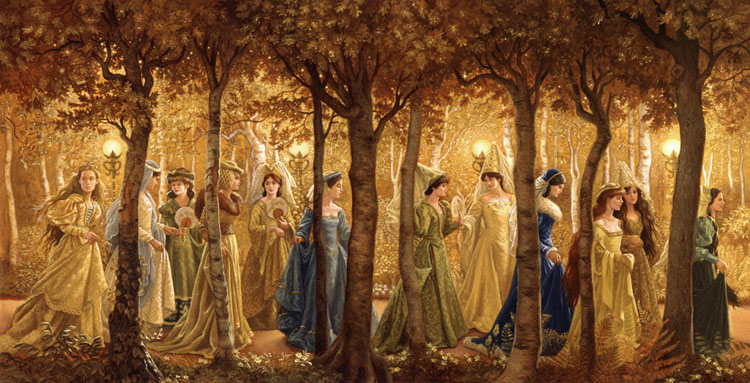
Alright, so the sausage was a big hit with the class. I also found it a little odd and unnerving and really strange as a pair with a sausage, bird, and mouse working together in their home. However the story that left a big impression on me somehow was “The Shoes that were Danced to Pieces” because it was so dark, and the princesses were so very rude. They were literally murdering these princes and then laughing about it! Moral: don't do what your not supposed to because in the end you'll get caught. That is all fine and dandy, but what about all those decapitated heads that those princesses didn't care about enough to save. I mean I guess the princes should have stopped doing it after the first few failures but what can you do? I mean another prince always needs to go slay the dragon for the princess…..but really this story was just like a cold hearted massacre.
The other story that stood out to me was, of course, “The Juniper Tree” which had all the delicious makings of a great story (I'm so sorry). I think the concepts of reality is off so much in this story. The boy is eaten….but comes back to life. The boy's head is cut off with the apple box…stepmom wraps it in cloth back on the neck and it magically stays? Boy turns into bird….and can carry limestone. I understand that this is a magical fairytale but please have at least a few concepts that are realistic. However, I did love how the stepmom goes bonkers at the end and then just gets crushed with a limestone slab that is dropped by Bird Boy Superman. I like the justice behind it, but also what is up with the family (it's like they don't even care she's dead) I know she is terrible and all….but ouch, no mourning.
I really love Shakespeare, and the Tempest is one of his plays that has always caught my attention because it is such a different style, and scholars debate on what genre it falls into (already it sounds fascinating). Is it a romance or a comedy?....let's be honest, it's a rom com.
I was of course extremely interested in the relationship between the magical beings in the play, Prospero and Ariel. So Prospero rescues Arial from a witch (whoa witchcraft) and then also begins to use Ariel as he pleases. Was he even rescued? I feel like he was enslaved and then enslaved again, he really was never free. But also I think that is another point of the play. The characters really have no freedom: one being trapped on an uncivilized island, and two having Prospero as the leader of all things. It's really interesting seeing the monarchy between four people, until of course, the other shipwrecked chaps are involved.
Speaking of the shipwrecked chaps. I really love Trinculo and Stephano especially because I'm a sucker for comedic relief characters. However, when they both stumble across Caliban and think he is a mutant fish and and a monster it is really dumb, but hilarious. Their innocent and unplaced humor is still funny even in this time because of its ridiculousness. They both mostly think of profit (money) and drink which is something related to civilization. They go as far as to give the native Caliban some booze and he starts calling them gods! The whole situation is weird but I really like the corruption of nature (Caliban) with the poison of civilization (liquor).
Trinculo (left), Stephano, and Caliban from Tempest (2010)
Also the movie was okay, but also now I sometimes confuse Prospero as a woman it's a problem.
Understanding some of this week's material was...difficult. Julian was great at establishing her ideas, but after a while her message, at least to me, became muddled in repetition of God's love and how God's love is great in this way and that way. It made me wonder if being an anchoress for so many years finally got to her.
The face of true sanity and serenity. (Source: www.juliancentre.org)
Joking aside, I wonder how Julian's book was received at the time of writing - I couldn't find any era-specific response to it, which was surprising considering a woman (gasp!) had a controversial view of the Church. The God and Jesus as mother of humanity idea is very interesting and makes a lot of sense, even in the context of the Bible and popular Church belief, but was surely put down by male clergy. Or maybe not? It is known that Julian was highly respected in her community, so perhaps her anchoress status gave her extra sway to at least express her ideas.
I do wish, though, that later religiously-prominent figures (looking at you, Luther and Bodin!) had taken a leaf out of her book regarding God's love. Julian focused on love and understanding and left out most of the "punishment of the wicked" rhetoric that pervades many other religious writings, which along with Hildegard's writing and music was a nice change of pace for this class. I'm still confused as to the criteria the Church used to determine who was a witch, when so many parallels can be found between magic users and visionaries. The only major difference I can see is the inherent "badness" of the visions seen by those accused of witchcraft. But, Hildegard and Julian lived quite a while before the height of the witch craze, so maybe that will become clearer as we move on.
Yet another adventure delving into "why women are more applicable to devil worshipping". However this is not anything new and it was already said that women were frivolous and sinful, like they were beacons of evil. "For every one man burnt for witchcraft, there are ten women burnt...women are more likely than men to be witches because of their instability of spirit, because they are understood better than demons, and because of their talkativeness" (238). That is good old William of Paris' reasoning: totally invalid. How did he even come up with such a riveting and evidence supported argument! He must have staged a competition between men and women and their ability to hold a conversation with demons....? Lame, this guy was lame. Yet, I did like the hilarious "witch milking an axe-handle".
(Any way you look at it, that's weird. Also pg 254)
It was a clever concept that the witches were not actually flying, but were imagining it. It is more realistic that the confused women believed they were flying and were actually being deceived by the devil. Except those cases where the devil actually allowed them to fly? I don't know, things get weird. I also like that during this time it wasn't just "Oh witch. Okay, execute." It moved onto "Oh witch. Okay, confess and repent. Give us some names. You will live but be punished/shamed." There was that new leeway that if the accused admitted to the crime they could be spared. Whoa, humanism. Moving up in the world.
(This is a pic of Johann Geiler Von Kaysersberg at the end of his life, also he died in 1510 two years after the Die Emeis, so accurate depiction of his striking good looks and wrinkles for days, he looks rude so I needed this here.)
I would like to start this blog post by saying that I am always peeved by preachers, and any text that I read, I always enter with a bias against them. In regards to Chapter 7’s preacher, Johann Geiler Von Kayersberg, I am equally as bothered by his preacher self and his preacher ways because of the artfully crafted manner that is presented. Kayersberg does not take the fear route of Bernardino—God’s wrath is going to come get us, ahhhhh!—but instead, his motive is appealing to the desire to understand and make sense of the plague that is witchcraft—I don't see witches flying through the sky, but does that mean they do not fly at night; surely a human cannot impact weather on their own, but then how do they do it? . He is giving his audience answers to questions, which, in return, means that they will consider what he says to be fact—regardless to if it is or not (which is why I lean towards anti-preacher).
The agenda of Kayersberg is clear, though, even though he is much calmer in nature than Bernardino (almost like if you put like Ben Carson and Donald Trump in a room together: they are appealing to the same concerns, but go about it in a totally different way and are attracting similar people). He wants to push this idea that there is a more vulnerable sect of the human race that can fall into the Devil’s assault on God—specifically females: “and why is the female sex more involved with witchcraft and the sorcery of the devil…?...because of their instability of spirit, because they are understood better by demons, and because of their talkativeness” (238). These attributes that are assigned to women can surely be found in the households of many of those who hear these words, and can result in accusations in the way that Bernardino encouraged accusations by means of fear. In addition, his message and information shows that magic is not always visible, and that a witch can do things under the guise of normal functions—such as meeting the devil in her sleep, and being transported mentally while remaining in a specific location.
This is a picture of one of my kittens, Bentley, who is clearly a witch because he is sleeping and kicked his legs a little bit, so the devil MUST be transporting him! (And he is a black cat, and Disney movies tell me he must be a witch) (&&& he is adorable and much cuter than the kitties on the Internet!)
At long last, it's the birth of the traditional witch hunt in all it's glory. Fear mongering, emotional knee-jerk reactions to the apparent enemy, and the immediate and forceful putting down with anyone and everyone who disagrees with your opinions that you believe to be 100% factual and correct. So basically just regular politics but with more magic and mass murder.
What really stood out to me in this chapter, though, is how absolutely abysmally these two guys feel about women. They keep going on and on about how women are weak mentally and easily corrupted, and how they're just a necessary evil used to have children but will make your life miserable in the process. According to them, women are only good when they're gentle and subservient, and any other time they are the manifestation of Hell itself. No middle ground, no thinking "Hey, maybe she's just unhappy that I keep her chained to the stove 6 hours a day," just one or the other. Sounds to me like they had super fun home lives as kids that caused them to develop some serious mother issues.
Of course I'm getting ahead of myself, because I must mention that right out of the gate Kramer and Sprenger disable any and all possible debate by basically saying that everyone who disagrees with them is stupid and evil and needs to be punished for not acknowledging the far mentally superior beings who are lords Kramer and Sprenger. This typical type of mentality isn't uncommon in people throughout history, but the difference between modern and olden times is that a figurehead doing that today will get him super far with a small portion of the population who just so happen to have the same ideas, and exactly nowhere with the vast majority that is the rest of the world. Trying to pull that nowadays will only have the influence of getting people to make fun of him over the internet in a manner similar to this:
A large portion of the rest of the text is them trying to figure out what exactly witches are and are not able to do, such as overturning the Canon's declaration that any bodily transportation occurs only in the imagination, because nobody can ever seem to agree on any of this. Seriously though, at this point you'd think that SOMEONE would have at the very least come up with some theorem that at least most learned people could agree upon, but I guess real people don't work like the scientific community and witchcraft doesn't work like physics, so it's probably too much to think that a medieval Einstein would come along and solve the puzzle of the proverbial ether. This is why my best friend is a statistics textbook with a face drawn on the cover.
Chapter 6. It was just awful. There were so, so many problems with Kramer and Jacob's arguments - from intense misogyny to torture to the obvious exceptions they made to their own rules! I wanted to accuse them of witchcraft by the time it was over - see how they like feeling that helpless against the long arm of the Church. Don't get me wrong, I'm unfortunately fairly certain that some of the horrible things described that witches do were actually done - certain rituals were described very specifically, and in the society of the fifteenth century, if you heard that hurting someone would somehow protect you from the dangers of the world...and if you might be able to get away with it...well, why not try it?
No! The point was to GET AWAY with it...*sigh* (Source: commons.wikimedia.org)
But i can't imagine a situation in which most of the accused aren't innocent.
The point I'm trying to get at is the Inquisitors were taking witch-hunting way too far. For example, look at the explicit instructions on how far to go and on which days to torture people to force a confession out of them, as well as how often to "change it up," like on page 214 (K/P): "For if the sons of darkness were to become accustomed to one general rule [of questioning or torture] they would provide means of evading it as a well-known snare set for their destruction." The Inquisitors are dealing with, for the most part, regular people, and they've set up what seems to be a sham judiciary system in which no one is innocent of witchcraft - not even themselves.
There were a few "gotcha" moments reading this chapter that I'm sure Sprenger or Kramer would figure out how to explain away, like this prayer that reeks of magic: "I conjure you by the bitter tears shed on the Cross by our Savior the Lord Jesus Christ...[many more examples of biblical tears]...that if you be innocent you do now shed tears, but if you be guilty that you shall by no means do so." (K/P, p.215, my italics) Or this magical amulet that is totally religiously acceptable: "...they [the Judge and assessors] must always carry about them some salt consecrated on Palm Sunday and some Blessed Herbs. For these can be enclosed together in Blessed Wax and worn round the neck...and that these have a wonderful protective virtue..." (K/P, p.216) Guys, I thought that all types of magic and magical items were heresy? Then there are the stories of judges being manipulated by witches if the witch can see the judge before he sees her, or of judges being bewitched by the way that witches speak during trial (p.216). But weren't judges protected by God and therefore immune to the wiles of magic? Oh, God must be allowing it to happen again.
The worst, though, was the section on midwives and those who cure illnesses and disease, who were thought of as just as guilty as a supposedly murderous witch! All because in order to expel enchantments and demons, you have to know how they were made and summoned in the first place. So...what about all those exorcisms performed by members of the Church?
In order to enter "the sect of the damned" one must "kiss this [toad] creature on the hind quarters and some on the mouth; they receive the tongue and saliva of the beast inside their mouths (KP 115)." But then the "novice" must kiss a wasted black eyed man from which "catholic faith totally disappears from his heart (KP 115)." No, but this is not all then they have to kiss the butt of a cat statue and say how unworthy they are and then have a giant orgy with no discrimination, because you know, devil worshipers. I just need to say how ridiculous this is,I know all of these rituals have been pretty bizarre so far but this one has definitely taken the lead. It is so very weirdly detailed and it makes me once again question how this Pope Gregory IX got his info. Was it secondhand? Thus, can it be true that this happened? Or was he like peeping in on these devil worshipers' orgies like "whoa that's cray! I'm totally writing this down in my journal." (Super creepy painting look at those weird creatures. James and Hermogenes. Musee Valenciennes) Also everything was out of proportion. The poor servant, Alice Kyteler, was executed for sorcery because of a family dispute on land distribution (KP 121). People were just dropping demons and sorcery around to get their way. So selfish, what a terrible lot of people. Remember kids, if your getting bullied just tell a higher authority that they are practicing witchcraft and you can watch your bullies get roasted on a stick. Wow, what a win win.
I was also horrified at the thought of women eating their own children. It was said that they kill them and sometimes ( if not their own child) place them back into their beds like it was an accident. Or that they boil them and grind them and like put the goo on their skin or drink it ( KP 157). It makes my stomach churn, I hope this really didn't happen and that it was just an exaggeration gone wrong. And of course if I was in the wife's position and (probably actually innocent) was being burned at the stake I would also be cursing all of those guys too. I understand the giant age gap and the hysteria with devil worshiping, yeah it's scary, but also just because a woman is cursing you while she is being tortured and burned at the stake does not mean you made the right decision, sorry bro. I do not worship the devil and I would still curse someone to hell if I was being burned alive, just saying.
For starters, I am so tempted to go on and on about the
article I particularly focused on for my presentation on Monday (Bernardino of
Siena), and how it reminds me of fear mongering Donald Trump, but I will save
my comments for myself, and my opinions on the implication of the preacher’s
words for class on Monday.
i had to....
What I will focus on is the imagery of these passages we
have been reading. Instinctively, these ideas and theories are laughable: how
could humans think such things? But when I read what these passages are saying,
they feel real (not in the sense that I think magic is real, but in the sense
that I understand where these people are coming from). There is just so much
detail. For example, in article 18, Pop Gregory IX is writing a letter about
seeking out heretics. The modern mind would read this letter and think “how the
hell can this be true,” but it reads so true to him. He dictates the events
that are carried out: a novice is received, “a shape of a certain frog appears
to him, which (BTW)some are accustomed to
call a toad” (115). He continues to say that some kiss this toad on its
mouth, others on its tushy… and I’m just like how can there be so many
variations of this one ceremony if it isn’t true? In the same paragraph, Pope
Greg (can I call you Greg) writes that once the frog (or toad, depending on
which of the numerous ceremonies you are attending and who is in attendance) is
kissed, the body of the novice grows cold and the “memory of the catholic faith
totally disappears from his heart.” This stood out to me because it almost felt like he was there... all of these times...and was able to reference all the different type of people he saw there. Just a theory...
I also thought it was interesting how little they trusted
the faithful. This can go either way for me. On one end, these people are
worried that the faithful may stray because they were once faithful and they
have strayed (they being the preachers, popes, etc) or, on the other end, it is
because they consider the faithful to be weak. Both options are a little bit
sketchy to me. Especially since they consider their warnings of what magic leads to "charitable," as if they know what is to come.
Overall, I think this whole thing from churches and theologians is deceptive and I wish there was like a diary I could read from these guys that exposed them on all their sneakiness... sort of like now, where our leaders emails get hacked and we get to know all the juicy, shitty stuff they did and lied to us about.
Reading chapters 2 and 3 of the Kors/Peters book, all I could think was, "For people who condemn demons and magical practices, you saints and holy writers sure know an awful lot about the particulars of how they interact with humans."
"Hey, so how do I summon the Devil? Oh, uh, it's just to make sure no one will do it." (Source: www.traditionalcatholicmass.com)
The evolution of discovering the prevalence of magical practices, addressing them, and universally condemning them I found particularly interesting. Before the 14th century, magic was considered "singular and episodic, one more manifestation of Satan's usually unsuccessful attempts to tempt mankind from orthodox belief and practice." (p. 59) And yet we have a prominent figure in early(ish) Christianity, Thomas Aquinas, part of whose writings in the 13th century were meant to "explain precisely how it was possible for demons to influence human actions." (p. 88) It seems like the clergy during this time period wanted magic and demons to be compartmentalized, dealt with, and left behind as they moved on to more important things. If they described exactly how these "episodic" incidents happened, for example the nature of demons and the extent of how they were able to tempt man, then righteous men (I almost typed "and women" there regarding 13th century Christianity, silly me!) would rise up against any temptation, ever again, because they would know how a demon would go about tempting them.
Speaking of my "and women" comment up there - there were so many descriptions in these chapters of how women were the ones who were usually corrupted by magic, and men only occasionally, and only if they were "weak." Not cool, people. Get over your superiority (even though I know you won't for hundreds of years. If that.)
Considering the eventual acceptance of magic as a widespread (or at least, more widely noticed) event, I was very surprised to read about the penances for various sinful magical practices. It is firmly established that magic and communing with demons is a sin of varying degree based on the results of the magic, but I was expecting more "Burn the heretics at the stake!" and less "Eat bread and water for ten days or so." In fact, in some cases using demons seems okay - even though it's a grave sin, it might be permitted to use them and then just ask for forgiveness, even if you know you're sinning. (p. 89, paragraphs 2-3) Further, according to Augustine, "all divinations are to be avoided; although physical death ought not to be inflicted without grave cause." (p.89) I wonder when the pivotal shift occurred to go from (comparatively) light punishment and repentance at this time to death by burning in the 17th century.
"Have you ever felt like you were just born in the wrong time period?" (Source: www.whenintime.com)
Another thought: while invoking Christ or the cross for various incantations or charms did happen in our other readings from Keickhefer, I feel like the magic in those readings was much more generally secular in nature. One of the big themes throughout Thomas Aquinas' writing selections was that all magical things come from demons, and all demons and magics are only permitted to act by God. I thought this was an interesting rationalization or analogy for how bad things are allowed to happen to good people - everything is God's will, be it good, bad, or ugly. Whatever you have to say to make yourself feel better, Mr. A.
In this weeks reading, Rachel forgets all about the fanciful, dark, and magical adventure this book is supposed to be as she becomes very confused and frustrated at the arguments and opinions of various authors in the text. First of all, Burchard of Worms somehow ends up saying something about how magical acts cannot happen directly on the body, with no other sources but some examples where that thing doesn't happen, none of which appear to actually say it's impossible. Then, Ralph of Coggeshall implies near the end of his work that's it's better to renounce what you believe in out of fear of death instead of nobly standing your ground, but only when you're not Christian or Jesus himself. Finally, in chapter 3 Thomas Aquinas truly embodies the spirit of modern argumentative reading by using questionable sources and manipulative logic to ultimately create something genuinely boring and hard to read.
As for my opinion on Burchard's text, I will admit I've never actually read any of the stories he has referenced and therefore don't know for a fact that none of them explicitly related the impossibility of magical acts happening directly upon the body. However, Burchard introduces them in the context of the magical acts occurring in the soul as opposed to the body, but only that much doesn't matter because correlation does not equal causation SIR, and that is quite the leap of logic either way.
My anger towards Ralph probably stems from my deep, deep hatred of confirmation bias, of which this is a prime example. Obviously, since he, as well as many other people, believe Christianity to be the one true religion, when Christians do noble deeds it's seen as wonderful and Holy, but if someone else does something the exact same way it's seen as evil and misguided. Intolerance breeds hatred, so not cool bro.
Other than picking up a few instances of him making some major assumptions (such as the validity of his sources, but I won't go too much into that because everyone has to make that assumption to an extent), and watching him clearly play with his reasoning in a very particular way to make his point ("Planets can't affect intellect because they don't have brains" somehow doesn't seem like a very solid foundation when you're talking about MAGIC), I don't really have much to say about him because he was just so boring to try and read through his stuff that I really don't want to take the time and effort to sort through every painful detail of his painfully long text just to get even more irritated at him.
In the end, my nature as a math major who must know how to write proper logical proofs, as well as a logic puzzle aficionado, has clouded my eyes to the actual content of the material and made me unnecessarily angry at dead people not making sense because that's not a waste of my energy or anything. Now Rachel is going to go take some ibuprofen to quell the raging headache that has spurred from reading all of that and calm herself with a nice murder mystery.
In
a world where giant, green men with very large axes simply stroll into Arthurian
courtyards during Michaelmas...but can you imagine if there was more than one
Green Knight? That’s a bit scary. This is probably my third time reading this
story and this part is probably my second favorite; since I am quite fond of
the whole “an honorable end for an honorable man,” so I like the weird ending.
But this part always sticks out, because you know, decapitation. Yet even so “that
scalp and skull now swung from his fist/…and it opened its eyelids, stared
straight ahead/ and spoke this speech…” (SGGK 49). The supernatural way that he
simply addresses the court like some headless horseman makes the story really
come to life (no pun intended).
However one of the most important questions to
ask is: Why green? Why not a Blue Knight? Why are this Knight and his horse
cantering into the great hall sporting this secondary color? The most common
symbol for green is envy and jealousy so would that mean that this mysterious
Green Knight is jealous of King Arthur, his court, his followers? So many
questions, so little time. The first lines that tell of this unusual pigment in
his skin: “Amazement seized their minds/ no soul had ever seen/ a knight of
such a kind/ entirely emerald green.” (SGGK 30). There is an intended emphasis
on “emerald” since it creates alliteration with “entirely” and with this the
knight is put into a noble light since emeralds are jewels which would NOT be
associated with a lower born person or even a small-fry knight. My guess is
that this honorable green knight heard about all the brave deeds and heroic knights
and their love of their king, he got real envious because he lives alone and
forgotten in the corner of the world and he comes to the court because he wants
to be noticed and talked about like the famous king.
Also
I feel like I should also talk about the other reading we had, “The Canon’s
Assistant Tale” which was interesting in how terrible the people in it are.
Especially the part where the “rascal canon” swindles a priest with his false
alchemy. First of all that priest is way too gullible and a bit corrupt if he
is all about making illegal money, probably for himself. And then the swindler,
well, I have mixed feelings about him since he is obviously talented about his
work and is renown through the town, but also he is a fraud. “That scoundrel
canon, whom the devil fetch/ Out of his bosom took a seeming charcoal/ A bit of
beech wherein he’d bored a hole/ In which he’d placed an ounce of silver
filings…” (CAT 442). Obviously what the fraud canon is doing is horrible, and
he is using alchemist pretexts to swindle wealthy, ignorant people who want to
believe in magic, and a quick way to more money. Yet, in a way he is just
trying to make money and survive, it is his livelihood, and he is good at it.
Somehow I saw him more as a corrupt salesman.