Alright, so the sausage was a big hit with the class. I also found it a little odd and unnerving and really strange as a pair with a sausage, bird, and mouse working together in their home. However the story that left a big impression on me somehow was “The Shoes that were Danced to Pieces” because it was so dark, and the princesses were so very rude. They were literally murdering these princes and then laughing about it! Moral: don't do what your not supposed to because in the end you'll get caught. That is all fine and dandy, but what about all those decapitated heads that those princesses didn't care about enough to save. I mean I guess the princes should have stopped doing it after the first few failures but what can you do? I mean another prince always needs to go slay the dragon for the princess…..but really this story was just like a cold hearted massacre.
The other story that stood out to me was, of course, “The Juniper Tree” which had all the delicious makings of a great story (I'm so sorry). I think the concepts of reality is off so much in this story. The boy is eaten….but comes back to life. The boy's head is cut off with the apple box…stepmom wraps it in cloth back on the neck and it magically stays? Boy turns into bird….and can carry limestone. I understand that this is a magical fairytale but please have at least a few concepts that are realistic. However, I did love how the stepmom goes bonkers at the end and then just gets crushed with a limestone slab that is dropped by Bird Boy Superman. I like the justice behind it, but also what is up with the family (it's like they don't even care she's dead) I know she is terrible and all….but ouch, no mourning.
Showing posts with label The Shoes That Were Danced To Pieces. Show all posts
Tuesday, November 17, 2015
Sunday, November 15, 2015
There Once Was a ______ Who Was ________
Reading fairytales in this class has been such a treat. Yes, because they're much easier to swallow than Kors and Peters, sure, but also because none of them are what they seem. I've always (well, at least since I've been in school) known that they are far from innocent tales and that they typically have dark and twisted morals, but I never realized just quite how dark they truly are. The first batch of readings were mostly fairytales that I've heard of before and they only had a few bits of variation to them, but out of this group of assigned tales, I've never heard of any of them before. Contrary to the majority of people, I didn't really grow up on fairytales. My favorite books when I was younger were the watered down classics for kids, the Little House on the Prairie books and odd things like The Magic Treehouse and Secrets of Droon series. When I was even younger, I liked things like Eric Carle and love the Very Hungry Caterpillar and Papa, Please Get The Moon for Me (which is why I chose The Moon as one of my picks)
But besides the hidden innuendos, dark themes and double-meanings, the aspect of these tales that I can really appreciate are the patterns. Dr. Sandona talked about fairytales during his portion of the Approaches to Literature class when he discussed structuralism, and now that I can get past the organization and categorizing that broke the rules of Literature and drove me nuts from this school of theory, I absolutely understand what he was saying: there is only one story.
While I hate the thought that every story can be traced back to a few different patterns, I will admit that the majority of stories and tales can be predicted to end a certain way. Once in a while, we'll get that jaw-dropping surprise ending, but after you've read enough books, you can pretty much guess the ending. With fairytales, this seems to always be the case. Maybe we didn't know that this stepmother was going to decapitate her son and let his head roll into a trunk of apples, but we knew that she didn't like him and that her jealous and disgust wasn't going to lead this boy into a happy ending.

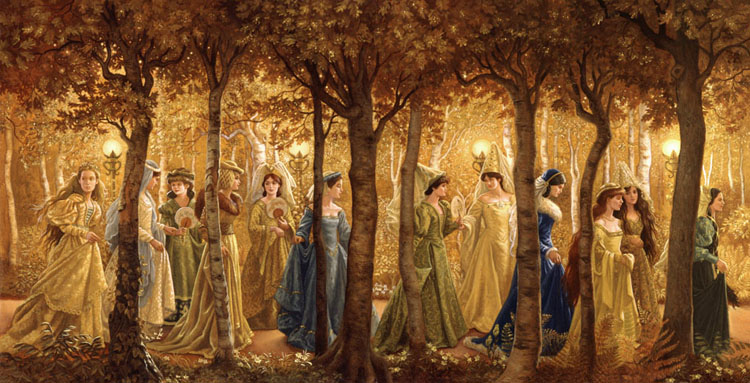
There are distinct patterns in all of these stories, and while not all of them follow one specific pattern, there are a good two or three that we can categorize together into groups of similar stories. For example, The Three Snake Leaves, The Riddle and The Shoes That Were Danced to Pieces are three different tales that all have similar patterns. In each of these, there is one princess, or twelve princesses, who each have some sort of quirk, but the king promises that if a prince can solve this quirk or is willing to accept it, he will be able to marry the princess, and if not, he will die. It's also interesting to note that all of these princesses are beautiful. The only quality they are ever given is beauty and the only reason a prince caves to follow her's or the king's orders is because she has such great beauty. In fact, beauty seems to be their only redeeming quality. The princess in The Three Snake Leaves, grows out of love with the prince, lusts after another man and kills the prince even after he has managed to revive her life and was willing to be buried alive with her. In The Riddle, the princess doesn't know the value of all the men who have lost their lives and thinks it's laughable that they are killed if she solves their puzzle. Even when she doesn't have the answer, she will not accept defeat and take the man as her betrothed, she lies and cheats to get the answer with the hopes that this prince will die too. And the twelve princesses are so vain and self-composed that they (except the youngest) never think it would be possible for a prince to outsmart them.
In a way, this pattern can be seen as empowering because these women all believe they can outsmart men and have their own plans. However, it always takes a turn for the worst because man trumps woman each time and the princess ends up punished or married. In fact, in all of these fairytales, once a woman is beyond the age of a little girl like Gretel, she is seen as manipulative, with high orders demanded of men and selfish or she's a downright evil stepmother/mother or a witch! The only innocent females are ones who can be classified as children and anyone who is older is never as intelligent, witty or resourceful as a man. It's sad that while it appears innocent on the surface, there are certainly misogynistic undertones in fairytales. We've always known the damsel in distress pattern, but even when that is not the case on the surface, women seem to always be getting themselves into trouble, or at least, that is how it is presented. Fairytales have never quite been for children, but it's children who read them and have lessons ingrained in them from the start whether they know it or not, and it's only when we've grown out of innocence ourselves that we can see what we read as children wasn't quite as innocent as we'd thought. There is absolute comfort in a pattern and that's why we're soothed by fairytales and tell them to our children, but what are we really teaching them?
Subscribe to:
Posts (Atom)


